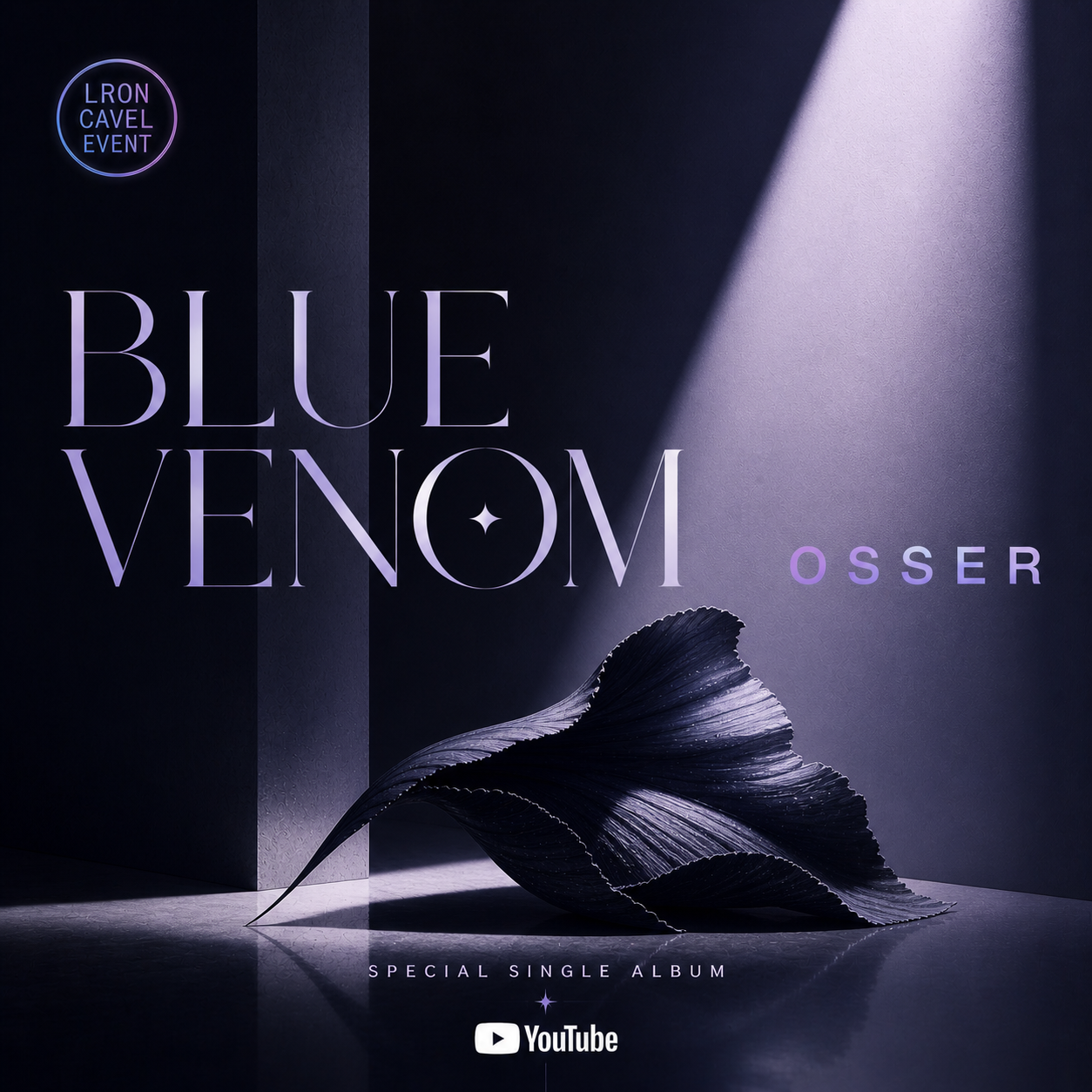
BLUE VENOM arrives with the strange confidence of a song that knows it has been built for a larger map. Its subtitle, FROM LRON CAVEL EVENT 2026, places it inside a promotional frame that could have swallowed a less disciplined group. Event singles often come burdened with assignment: announce the brand, widen the audience, give the visuals something expensive to hold, make the hook portable enough for international listeners who may not know the full story. OSSER meet that assignment without sounding entirely domesticated by it. BLUE VENOM is polished, strategic, and absolutely aware of its surface, but it keeps a little poison under the gloss.
That poison matters because OSSER are not most convincing when they chase size. Their best songs feel pressurized rather than huge, as if the walls are closing in and the members have decided to turn the shrinking room into choreography. BLUE VENOM understands this. It does not attempt to overpower the listener with maximalist production. Instead, it moves in cool beams: a low pulse, glassy synths, a hook that seems to glow from behind a curtain rather than burst through the front door. The track is international in its restraint. It knows that scale can come from focus, not only from volume.
The first verse is almost suspiciously smooth. OSSER enter with a kind of clinical elegance, each line placed as if the group were arranging evidence on a steel table. The production gives them space to sound expensive but not indulgent. There is a faintly nocturnal quality to the mix, the feeling of a luxury corridor after midnight, when every surface reflects too much and every footstep sounds like a decision. This is familiar territory for the group, but BLUE VENOM refines it. The threat is less theatrical than on PUNCTURE, less wounded than on EARING. It is cleaner, and sometimes cleanliness can be its own menace.
The hook is where the song makes its commercial case. It is not the kind of chorus that knocks the chair backward; it coils. The melody is simple enough to travel, but the performance gives it a frozen aftertaste. OSSER do not sing the phrase as a confession or a warning. They sing it as if the venom has already done its work and the rest is merely observation. That composure gives the track its best dramatic effect. In a pop field where many event singles mistake urgency for personality, BLUE VENOM sounds more dangerous because it refuses to hurry.
Still, the song's elegance has limits. There are moments when BLUE VENOM seems so committed to being sleek that it avoids the mess that could make it unforgettable. The bridge gestures toward rupture but pulls back too quickly. The final chorus adds width, not chaos. For a song named after poison, it is remarkably careful about dosage. That control keeps the track replayable, but it also keeps it from reaching the feverish high of OSSER's sharpest work. You admire the design more often than you feel trapped inside it.
The members, however, give the song a human grain that the production sometimes denies. SANNO's tone cuts through the blue light with a dry confidence; TINK brings a sharper attack without breaking the mood; LAN and PARK understand how to make softness sound suspicious; MARON closes phrases with a firmness that keeps the track from evaporating. The distribution does not feel revolutionary, but it is intelligent. Nobody is asked to oversell the concept. The group move as if they have been told that the most frightening thing they can do is remain calm.
As a CAVEL EVENT entry, BLUE VENOM also reveals how LRON ENTERTAINMENT is using the event format. The label's recent releases have not all chased the same market center. KITTIES were aimed through a European sheen, FiVe through a warmer but heavily promoted single lane, and OSSER here through a colder, more global pop architecture. That range is commercially useful, but it also risks turning the event into a showroom. BLUE VENOM survives because it does not sound like a product demo. It sounds like a group using the showroom's lighting to make their own reflection look stranger.
There is a subtle regional intelligence to the song. Its pop frame is broad enough for U.S. and European playlists, but its vocal drama remains rooted in the precision of idol-group architecture. It does not flatten OSSER into generic global pop. Instead, it translates their tension into a cleaner dialect. That translation is not always thrilling, but it is rarely embarrassing. The group keep their edges, even when the track sandblasts them for wider circulation.
The closest comparison in OSSER's recent catalog is not PUNCTURE but the idea behind EARING: a small emotional object treated as if it might contain a whole weather system. BLUE VENOM is less intimate, more aerodynamic, and more commercially legible. It may not cut as deeply, but it moves farther. The song knows how to hold attention without pleading for it, which is a rarer skill than many pop campaigns realize.
BLUE VENOM is not OSSER at their most dangerous. It is OSSER at their most exportable, and the difference is worth noting. But exportable does not have to mean empty. Here, the group find a way to make polish feel a little diseased, to let a brand event carry a song that still has a pulse of its own. The venom is blue because it has been chilled, bottled, and lit for display. It still stings.
Reader Comments
Log in to comment, reply, or like comments.