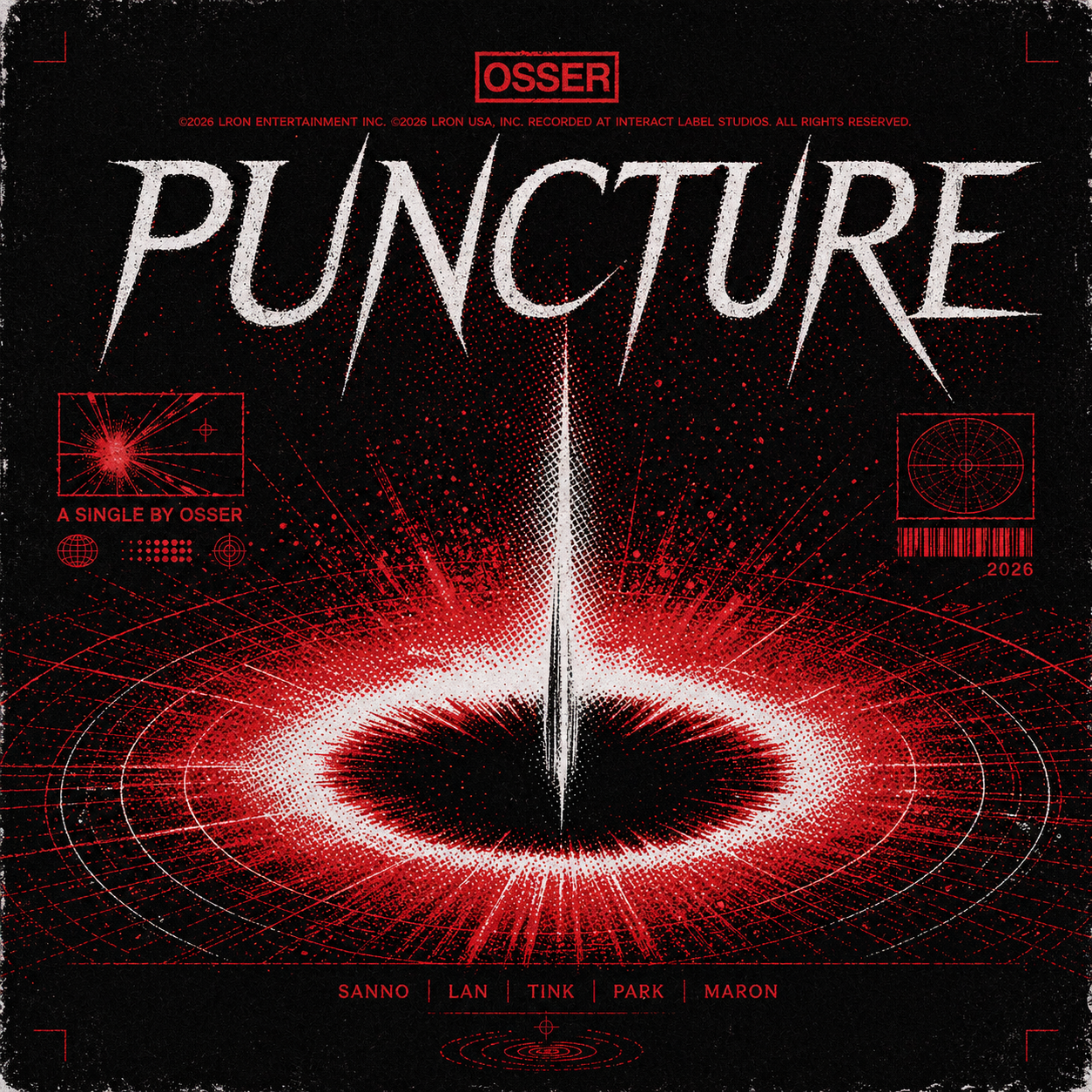
The first PUNCTURE felt like a clean threat. It did not need to explain itself. OSSER built the original around a hard little absence, the kind of negative space that lets a hook look larger than it is, and the song worked because it understood the pleasure of withholding. Its synths did not bloom so much as narrow. Its percussion did not chase spectacle; it kept tightening the room. For a group whose best work often depends on the sensation of five voices circling a shared pressure point, PUNCTURE was convincing because it felt less like a statement than an incision.
PUNCTURE (Single Version) tries to make that incision into an object you can rotate under several lights. The package includes the original, an Interact Label Remix, sped-up and slowed versions, an instrumental, and an acapella. On paper, that is a familiar streaming-era move: turn one track into a small ecosystem, give every platform a preferred tempo, every fan edit a sanctioned source, every chart calculation a few extra handles. The problem is not the strategy itself. Pop has always multiplied its singles through formats, remixes, radio edits, club mixes, live cuts, and alternate languages. The problem is that this package rarely turns multiplication into revelation.
The original remains the best argument here. Its power comes from the way OSSER make impact feel cold. SANNO and TINK cut through the first verse with a metallic calm, while LAN, PARK, and MARON thicken the hook without ever making it feel crowded. The writing is not generous; it is clipped, almost cruel, and that suits the song. PUNCTURE is most alive when it sounds as if the group is refusing to comfort the listener after drawing blood. The title is literal enough to be camp, but the performance keeps it from becoming cartoonish. There is no need for a dramatic bridge or a sentimental release valve. The song knows that sometimes the sharpest pop gesture is to leave the bruise unkissed.
The Interact Label Remix is the most substantial alternate version, and for a minute it seems ready to complicate the original. It opens up the low end, pushes the rhythm toward a more elastic club frame, and lets the vocal fragments flash against the beat like light on a blade. But the remix never fully commits to either violence or pleasure. It is too careful to become a real club reconstruction and too busy to preserve the claustrophobic elegance of the single. Its best moments come when it briefly treats the hook as texture rather than centerpiece, letting the group's voices dissolve into a feverish pattern. Then it returns to the obvious shape, as if afraid to damage the product it was hired to decorate.
The sped-up version is less interesting but more revealing. It turns PUNCTURE into something closer to a fan edit, smoothing the menace into momentum. The song becomes brighter, more searchable, less strange. That may be useful in the ecosystem that now surrounds pop singles, but it also confirms how much the original depends on weight. Without the drag in the rhythm, the pauses stop feeling dangerous. The hook arrives faster, but it lands smaller. The slowed version has the opposite problem: it stretches the drama until the track starts admiring its own shadows. OSSER can do gothic tension beautifully, but here the syrupy tempo makes the song feel less haunted than sedated.
The instrumental is better than expected because it exposes the discipline of the production. Beneath the vocal theatrics, PUNCTURE is built on a few careful decisions: a bass figure that seems to press inward rather than move forward, percussion that marks the room like a warning light, and synth details that refuse to become decorative glitter. Without the members, the track loses most of its personality, but it gains a kind of architectural clarity. You can hear where the song leaves space for breath, where it expects a stare rather than a belt. It is the only alternate version that makes the original feel more impressive by showing how little it wastes.
The acapella, meanwhile, is a reminder that OSSER are often more compelling as a vocal unit than their branding allows. Their voices are not interchangeable colors arranged for maximum symmetry; they carry different temperatures. One member sounds like frost on glass, another like a match being struck under water, another like someone smiling with their teeth closed. Stripped of the production, the song's writing looks thinner, but the performances look sturdier. The acapella is not something most listeners will return to for pleasure, yet it argues that OSSER's next leap may come from letting the members disturb the track more, not less.
That is the central frustration of PUNCTURE (Single Version): it keeps hinting at what could happen if OSSER's team treated an alternate release as an opportunity to interrogate a song instead of extend its shelf life. A great single package can reveal hidden rooms. It can make the original sound more unstable, more generous, more durable. This one mostly confirms what was already clear. PUNCTURE is a strong song; the versions around it are useful but rarely necessary. They give the track a broader surface without deepening its wound.
There is still value in hearing OSSER occupy this colder register. After EARING and the earlier PUNCTURE cycle, the group have been building a language of controlled damage: sleek, tense, emotionally armored, more interested in pressure than release. The single version fits that arc, but it also shows the danger of over-polishing a good scar. When everything becomes a format, even pain can start to feel like packaging.
For fans, this release will serve its purpose. It offers options, feeds playlists, and gives the original a longer chart shadow. For everyone else, the best advice is simple: start with the original and treat the rest as footnotes. PUNCTURE did not need to become a miniature franchise to prove its strength. It was already sharp enough when it was just a song.
Reader Comments
Log in to comment, reply, or like comments.