There is a difference between exporting a song and designing one to travel. "BLUE VENOM," the new OSSER single issued through the LRON CAVEL EVENT 2026 campaign, feels built with that distinction in mind. The group have spent the last stretch of their catalog specializing in pressure: metallic hooks, clipped emotional temperature, and an instinct for staging detachment as something almost ceremonial. This new record keeps those instincts intact, but it redistributes them. The arrangement is broader, the melodic silhouette is cleaner, and the chorus lands with a kind of legibility that suggests not compromise so much as calibration.
That matters because OSSER are releasing into a more complicated moment than a simple comeback cycle. Their recent numbers have shown the natural taper that often follows an intense burst of concept-heavy activity. "PUNCTURE" gave them a title sharp enough to pierce through the week, but it also reaffirmed how narrow their emotional tunnel can become when the entire presentation depends on one sensation. "BLUE VENOM" does not abandon the darkness; it reorganizes it. Instead of crowding every second with threat, the single opens space around the vocal line and lets the song travel on atmosphere as much as force.
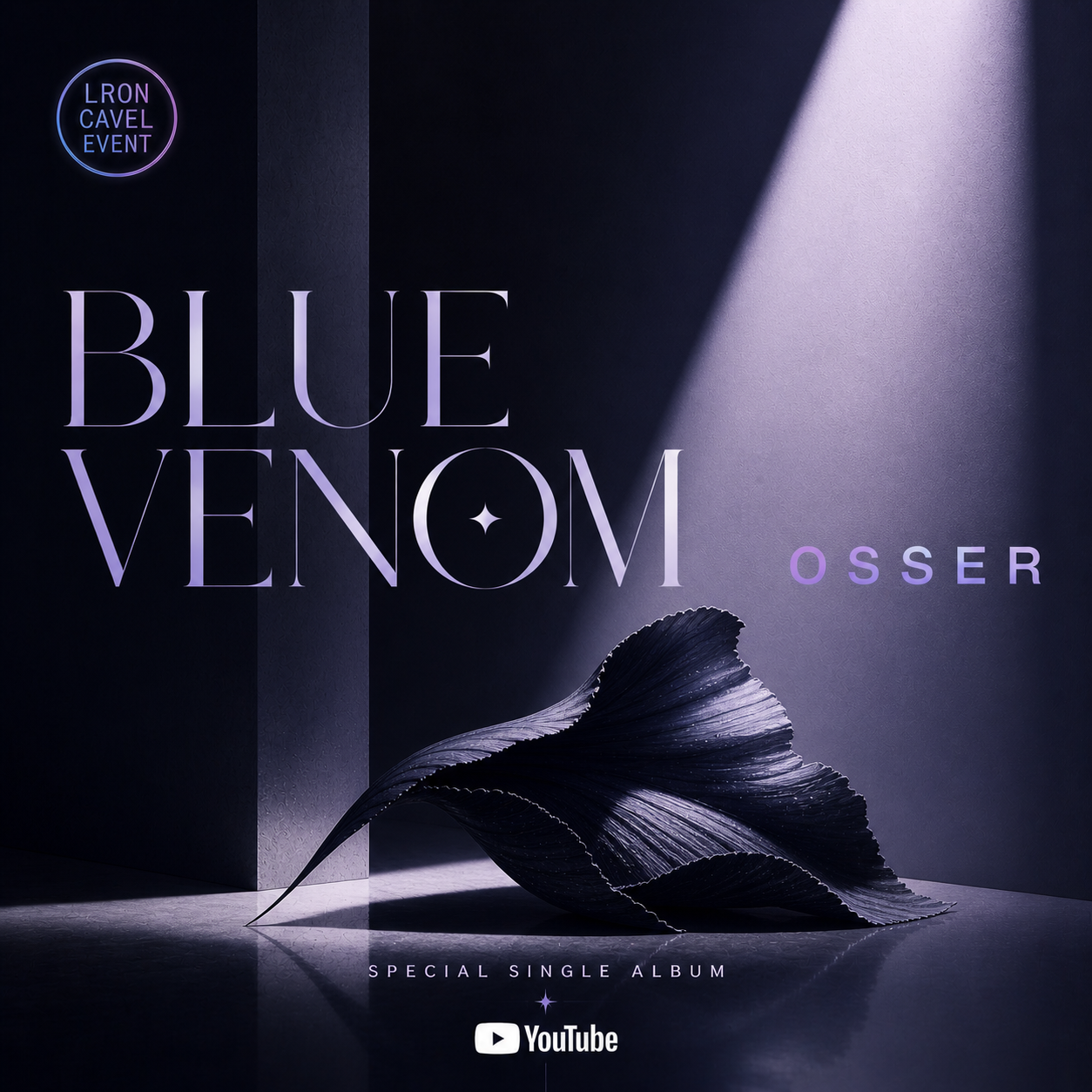
The packaging is part of the argument. The artwork places OSSER inside a cool-toned, spotlighted frame that reads less like a comeback poster and more like an export statement. Even the title behaves that way: "BLUE VENOM" has the kind of immediate visual clarity that crosses quickly between markets, but it still sounds like OSSER, not a focus-grouped approximation of what an international single is supposed to do. The event branding helps, too. LRON CAVEL EVENT 2026 has increasingly acted like a stage for controlled reveals rather than disposable side content, and this release uses that visibility to present OSSER as both identifiable and newly scalable.
On first contact, what stands out is how efficiently the song divides its labor. The production handles texture; the topline handles memory. That may sound obvious, but many songs advertised as global-ready make the mistake of flattening both. Here, the sound design stays cool and dimensional while the hook does the simpler work of repetition and shape. It gives listeners an entrance point whether they arrive through performance clips, chart pages, or algorithmic autoplay. For a group whose best material often asks the listener to submit to a mood before it yields a hook, that is a meaningful adjustment.
The international angle also shows up in how the single should move across regions. A track like this is likely to overperform in the United States and United Kingdom relative to some of OSSER's more locally coded records, but it still retains enough sleek tension to connect in Japan, Korea, and the Philippines, where stylized coldness can read not as emotional absence but as precision. In other words, the song is not trying to become placeless. It is trying to become portable.
What comes next will determine whether "BLUE VENOM" is remembered as a clever one-off or the opening edge of a better phase. If OSSER treat it as proof that they can widen their frame without draining their identity, the single may end up mattering more than its first-day chart story. If they fall back into pure concept compression, it will remain a handsome anomaly. Either way, it does the one thing event singles often fail to do: it makes a future feel newly imaginable.